Showing posts with label Expose. Show all posts

Monday, January 1, 2018

Self Portrait Acrylic Underpainting (Part 1)


When I was about ten years old, my father took me to the family home where he grew up along the rocky shores of coastal New England. At the time the house belonged to my dear uncle and aunt who had raised their children there, but the attic held remnants of past inhabitants. Among these items was an old set of oil paints that belonged to my father.

I've forgotten how it all came about exactly, but it seems that my dad had recognized my interest in art, perhaps even before I had become conscious of it. I was one of those lucky girls who had a father that encouraged her to explore her heart's curiosities; a trait he and I shared. Unfortunately, I also inherited his crippling passiveness which left me vulnerable to negativity and defenseless to authority, resulting in the limited faith I’ve had in my capabilities and personal worth in the world.

After retrieving the paint set and tossing any old paint that had dried up, my father gave me his paints and taught me the basics: how to prime Masonite panels (which he cut for me, and later taught me how to cut myself), mix paints, and clean brushes. I was on my own for the rest, but fortunately a friend of my father taped new Bob Ross episodes on VHS for me so I could learn to paint and take my time.

I had painted one big landscape (which I still have somewhere), and a few smaller pieces. I loved to paint mountains, evergreen trees, and water - a sure indication of what I would always consider paradise. To this day, I crave mountain vistas, and cannot fathom living away from a lake, the ocean, or at least a fresh running stream. And the trees... I have had nightmares of being without trees! There are plenty of oak, ash, and even birch trees around here, but not nearly enough pines, firs, and cedar for my liking. 

Unfortunately, for the last 25+ years, I haven't done much oil painting. I worked with it again in the early 2000s for one painting class, but because ventilation (and Teflon flooring) is needed, it just isn’t practical when living in rentals. But I’ve thought of it often, how satisfying it is, and vow to get back to it. Thanks to healthier solvents and cleaning alternatives, I am hoping to start painting in oils again.

I wanted to try to paint a portrait first. I had made my first [graphite pencil] portrait attempt in 2004 and was surprised by the results, but have since only done a handful of serious portrait attempts (in graphite). Since the human figure is now what I focus on in my personal work, I figured portraiture would be an enjoyable challenge. I decided to do a self-portrait because it would give me the best access to reference material, and historically it seems to be an unspoken requirement if you’re going to take yourself seriously as an artist. It reflects physical appearance, as well as personal background and style. Underpainting has been a technique I have wanted to try for a long time. It's what the masters often used, and it makes practical sense.

Layer One: Acrylic Underpainting (Grumbacher: White & Raw Umber)

This is only the finished underpainting. I think I went a little overboard with the detail. It's my understanding that underpaintings are not so tight and blended, but I am particular and wanted to do a good job. Plus, once you get in the zone things just happen. I just hope the oil paint layer doesn't completely ruin or negate all I've done so far. It is fairly dark and "harsh" right now, but I've tried to consider the transparency of the colors I will be using and how they will interact with the values on the underpainting. For example, if I were doing the composition in graphite pencil, I would have done the values differently and given a higher contrast between the skin and lips. However, red paint (applied to the lips) is translucent, whereas white (which will dominate the flesh) is opaque, therefore the skin will [theoretically] get brighter while the value on the lips will stay relatively as they are now with the underpainting coming through more in that portion of the painting. It’s definitely an experiment, and I hope my logic plays out well.

Honestly, I did this because I wanted to see what I could do. I had no idea if it was going turn out to be good or awful, but so far I'm satisfied and it's given me some hope for future paintings. It’s helping me expand in a direction that should bring me back to the type of art I have always loved, but wasn’t confident enough to create. So, in a way it's exploring in order to return home. As someone who suffers from hiraeth, the irony is not lost.

Monday, July 20, 2015

Brighid (Brigid, Brigit, Bride, Brighde)


Brighid is probably the most well survived deity and her popularity spans across multiple religions. Her name has several variations depending on country, time, or incarnation. She is popular, to this day, with both Pagans and Catholics.

Some believe that she is or is related to the ancient Goddess Brigantia or Britannia, while others maintain that they are separate deities. The Romans equated Brigantia and Britannia with their Minerva (and Greek Athena), a deity that has incredibly similar associations to Brighid, so it really is no stretch of thought to consider that Brighid, Brigantia, and Britannia could be related or different variations of the same entity. She is most definitely related to the Catholic Saint Brigid, as their associations mirror each other. This is no surprise considering many Gods and Goddesses were adapted as Saints when the new religion of Christianity came to the British Isles.

Brighid is the daughter of the Dagda, but her mother remains unknown. She is half sister to Oengus, Bo Dearg, and others. Sources often say she is one of three sisters, all named Brighid. While this seems odd to our modern minds, it is a common theme in Celtic mythos. Many deities come in three, three incarnations of themselves. Sometimes they are easily defined separately but related because they have different names and related but different traits, other times not. In this case, the three Brighid sisters are responsible for poetry, healing, and smith craft. The number three is considered an ideal and powerful number. It seems that when something appears in threes, it signifies and amplification of power or importance on that subject or entity.

Brighid is associated with fire, the sun, hearth and home. She brings and cares for new life, spring, healing, cattle and livestock. She breeds and nurtures creativity through poetry, smithing and crafts, wisdom, battle skill, protection, and intelligence. She is truly an all encompassing figure. No wonder she is a favorite!

Her other associations include serpents, boars, wells, and milk. Her holy day is Imbolc, which takes place on February 1st, which is also St. Brigid's Day.

She was married to Bres, a Formiorian, no doubt a political marriage. Her son was named Ruadan, who dies fighting for the Formorians, and through her mourning she invents the practice of keening (crying and singing). She also initiated the use of whistling while traveling at night to keep in good communication.

Brighid has a sacred temple that was tended to by 19 women. No man was allowed to enter. There are stories where a daring man or two decided to test this, and ended up either insane or injured. Other stories include her birth and adoption by Druids and Christians, her healing abilities, and her wit. often the lines between Goddess, Druid, and Saint are blurred. There are many stories, and if you would like to read more about them or about Brighid herself, I humbly encourage you to read this book: Brigid: Goddess, Druidess and Saint.

Sunday, July 19, 2015

Lugh Lámhfhada (Lugh of the Long Arm)


Lugh is a solar god, and the son of Cian (Tuatha de Danann) and Ethniu (Formorian), and grandson of Balor of the Evil Eye through his mother Ethniu.

As the legend goes, it was prophesied that Balor would lose his life at the hands of his own grandson. To prevent this, Balor locked his daughter Ethniu in a tower so that she may never meet a man. But Cian, who was out for revenge against Balor for tricking him out of his prized cow, asks a faery woman (Birog) to magically transport him into the tower where Ethniu is kept. He seduces her, and she eventually gives birth to three children.

Upon learning this, Balor orders the babies to be drowned in a whirlpool, but one was dropped and rescued by Mananan (some sources say Birog), who then gives the child to Goibniu to foster. Lugh eventually did kill his grandfather Balor, using a sling stone.

As a young man, Lugh travels to the court of the Tuatha de Danann king, Nuada. Only individuals offering a unique skill may join the court. Lugh is proficient in many things including his skills as a smith (undoubtedly thanks to his foster father), poet, warrior, musician, and more, but the court of the Tuatha de Danann already comprises of individuals with these claims. Ultimately, Lugh asks the guard if there is any one person who possesses all of those skills. When the guard admits there is not such a person, Lugh is permitted to join the court and is given the title of Ollam, or "master," "highest rank."

Lugh has many names, including Lugh Lamhfhada, which translates "Lugh of the Long Arm." He is father to the warrior Cuchulainn (by Deichtine), and ruled Ireland for many years. He possessed several magical items including a spear, two swords, a dog, and a pig skin that healed wounds, some of which he gained through the sons of Tuireann in compensation for slaying his father Cian. He was also in possession of a boat called "Wave Sweeper" which he borrowed or acquired from Mananan (he seems to have borrowed a few of Mananan's things).

Tailtiu (Fir Bolg) was Lugh's foster mother, whom is revered so greatly he instituted an annual festival of games in her honor. This we know today as Lughnasadh which commonly occurs on August 1st. The festivities celebrate Lugh and harolds in the harvest season. The holiday is where the Irish word for August (Lunasa) comes from. Lugh is also credited with the invention of Fidchell, an Irish version of chess.


About the work:

Here he is, Lugh the strong-armed sun God with the fiery surroundings of his forge. On the wall hangs some of his tools and weapons. His golden-haired head is haloed by a shield with a Le Tene style design that symbolizes his relationship with the sun. Before him is a game of Fidchell, ready to play. He wears a red striped tunic, a pattern and color well liked by the Celts. He has a look of confidence about his face, which is no surprise when you're as highly skilled as he is. There is a lot of symbolism associated with Lugh, too much to fit in unfortunately. Tucked in his belt is a sling shot, not exactly the weapon he would have used to slay Balor, but illustrating a true sling stone was not fitting well in the picture. For all the other items, I've tried to reproduce or be inspired by actual artifacts of the ancient Celtic age.


Tuesday, December 9, 2014

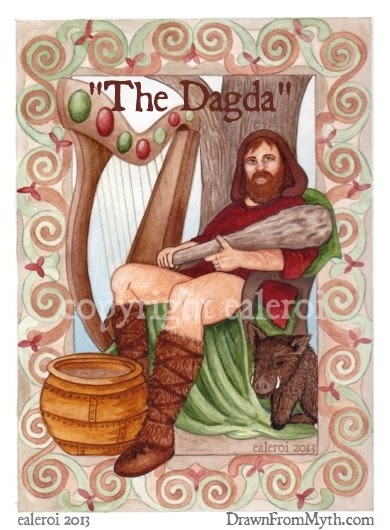
The Dagda

The Dagda (day-duh), a father deity also known as the "Good God" among several other names. He is also called Eochaid Ollathair. His parents are said to be Eltha (father) and/or Ethlinn (mother).

The Dagda is commonly known to be a bit clumsy looking or acting, but very generous and good. He wears a tunic that is a bit too short that exposes his rump and large member that drags on the ground. He possess several magical objects as the Gods often do. Among these are:
  • Undry, a large cauldron that provides an endless supply of food
  • a large club that could kill nine men with one end, and restore life with the other end
  • Daurdable, a harp made of oak that when played would change the seasons
  • Two pigs, one continually roasting, the other continually growing
  • Trees that constantly produced fruit
The Dagda was lover of Boann (wife of Nechtan), and lover of the Morrigan. Through Boann, he fathered Oengus Og (God of young love, youth, and poetry). In order to hid the pregnancy from her husband, the Dagda made the sun stay still, making it seem like only a day has passed. On Samhainn, the Dagda came acrood the Morrigan washing at a river. He copulated with the war Goddess in exchange for a battle plan or favor in battle.

The Dagda is the father (unknown mothers) of Brighid, Breg, Bo Dearg, Aine, Cermait, Midir, and of course Oengus. He may be brother to Oghma and Lir. The Dagda ruled the Tuatha de Danana for a very long time (after Lugh).


Wednesday, September 14, 2011

The Morrigan (Badb, Macha, Nemain)

The Morrígan is the first in the Celtic Tuatha de Danann series. Set against a stormy sky illuminated by a full moon, the three sisters Badb, Macha, and Nemain oversee the events of a battle. A crow flies over the scene of a blood stained background littered with fallen warriors, known as "the Morrigan's acorn crop" or "Macha's acorn crop." The Morrigan is a goddess of battle and death, but also fertility. Her name means either "phantom queen" or "great queen." She  is sometimes considered a single Goddess that is part of a tripartite, or the name of the tripartite itself.

Tuesday, April 5, 2011

The Modest Mermaid

Honestly what "inspired" this was a drawing I hadn't finished in one of my sketchbooks and I wanted to try out a theoretical painting technique and colors for a mermaid's tale. So in reality, this was a practice piece turned finished work. Oops. It happens. I love the blues in this piece and I really have to start painting more mermaids with hair colors other than red (thanks Ariel, who doesn't love her though?!). I tried to find a contrasting color to the aqua that wasn't going to be too typical, although terracotta tones are complimentary colors, so there wasn't a whole lot of thinking going on there. Plus I need a color to go with the aforementioned hair. I think it worked.

I've called her The Modest Mermaid because she's covering herself up with an old sail (thanks again, Disney) and because she looks a bit taken aback as if she's thinking "what are you looking at?" We've obviously disturbed her peaceful afternoon sitting upon her coral flanked sandy seat.


Tuesday, March 1, 2011

Priestess of the Sidh

I wasn't entirely sure what to call this one. Is she human in service to the sidh? She stands before a wheel of time offering a cup to drink from, framed by a runic blessing.

Her look is simple, with reflections of Celtic style (braids, jewelry, tunic), as she has more important things to focus on.
The wheel behind her depicts two separate sets of zodiac. The outer wheel shows the animal prints of the Native American zodiac.* The inner ring shows the Celtic tree calendar.** The script written in the border I adapted from a longer Scottish blessing. It reads: